
The concept of personal data lies at the heart of the General Data Protection Regulation (GDPR), shaping the scope of its protections and obligations. Among the most debated examples of such identifiers are IP addresses. While often perceived as neutral technical data, regulatory authorities and courts within the European Union have clarified that IP addresses can constitute personal data when they enable identification, directly or indirectly. Understanding why IP addresses fall within the GDPR’s scope requires examining legal interpretation, regulatory guidance, and practical realities of online data processing.
What qualifies as personal data?
Article 4.1 of the GDPR defines personal data as “any information relating to an identified or identifiable natural person (‘data subject’); an identifiable natural person is one who can be identified, directly or indirectly, in particular by reference to an identifier such as a name, an identification number, location data, an online identifier or to one or more factors specific to the physical, physiological, genetic, mental, economic, cultural or social identity of that natural person.”
The EDPB explicitly identifies IP addresses as being personal data due to their ability to identify individual data subjects. If an IP address is successfully anonymized, then under the GDPR it is no longer considered personal data.
The French Data Protection Authority (CNIL) ruled over a case dealing with the transfer of personal data to a company not in the EU. In the decision, the CNIL wrote:
“It should be noted that online identifiers, such as IP addresses or information stored in cookies can commonly be used to identify a user, particularly when combined with other similar types of information. This is illustrated by Recital 30 GDPR, according to which the assignment of online identifiers such as IP addresses and cookie identifiers to natural persons or their devices may “leave traces which, in particular when combined with unique identifiers and other information received by the servers, may be used to create profiles of the natural persons and identify them.” In the particular case where the controller would claim to not have the ability to identify the user through the use (alone or combined with other data points) of such identifiers, he would be expected to disclose the specific means deployed to ensure the anonymity of the collected identifiers. Without such details, they cannot be considered anonymous.”
What is an IP address?

An IP address is a way of identifying a device or user attached to the Internet. It is a set of numbers that distinguishes how the device requests and receives information from the Internet. The two main formats are IPv4 and IPv6. Originally, IPv4 was the sole way of identifying devices but it does not allow for as many unique addresses that are needed in the modern age.
The format of IPv4 addresses are xxx.xxx.xxx.xxx where x is a decimal number. The format of IPv6 addresses is hexadecimal (2001:db8::ff00:42:8329), which means a value can be 0-9A-F. Static IP addresses are IP addresses that are constant and dynamic IP addresses can change over time. IP addresses can identify explicit addresses or the exact location of devices.
The GDPR perspective on IP addresses
The GDPR explicitly includes “online identifiers” (e.g., IP addresses) as personal data when they can identify a person. Even if the controller doesn’t have the identifying data itself, if there are means reasonably likely (e.g., legal processes to get ISP logs) to link an IP to a person, then it qualifies as personal data. This logic comes from the CJEU case Breyer (C-582/14). The CJEU relied on Recital 26 of the GDPR, which states that in determining whether a person is identifiable, “to determine whether a natural person is identifiable, account should be taken of all the means reasonably likely to be used, such as singling out, either by the controller or by another person to identify the natural person directly or indirectly.”
IP addresses can be personal data if the controller has legal ways to obtain additional info to identify someone via an ISP. This is due to the objective possibility of identification of a data subject. Under the GDPR there is less concern with whether it is probable or whether it has happened and the concern lies with whether it is objectively possible to identify an individual. Given an IP address, it is possible to identify an individual. EDPB decisions affirm that online identifiers like IP addresses are often treated as personal data because they can be combined with other information to profile or identify a data subject.
Personal data vs PII
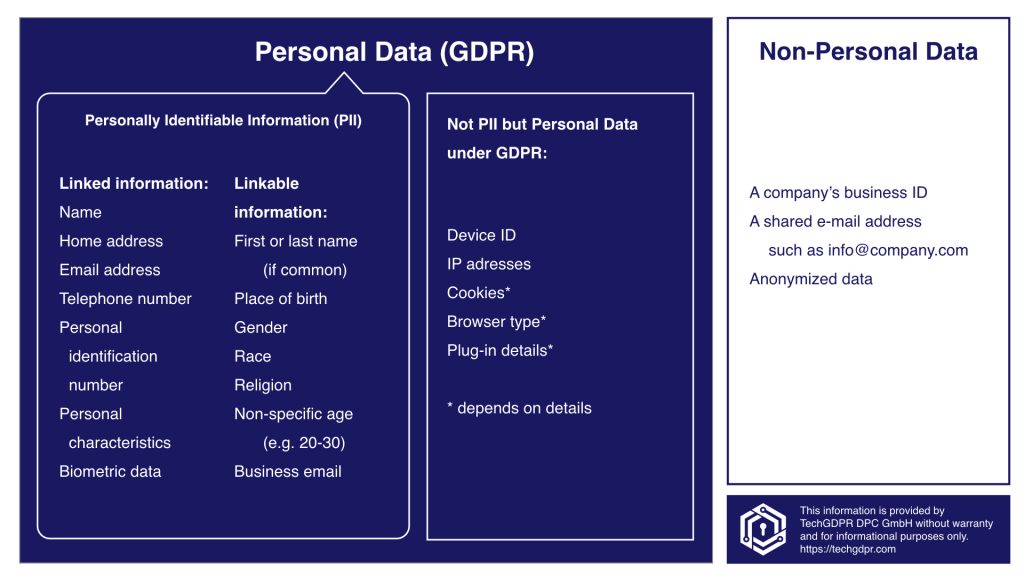
Personal data, in the context of the GDPR, covers a much wider range of information than personally identifiable information (PII), commonly used in North America. In other words, while all PII is considered personal data, not all personal data is PII. For more information about PII vs personal data, read our blog post on the matter.
Device IDs, IP addresses and Cookies are considered as personal data under GDPR. According to the definition of the PII; however, they are not PII because they are anonymous and cannot be used on their own to identify, trace, or identify a person.
PII includes any information that can be used to re-identify anonymous data. Information that is anonymous and cannot be used to trace the identity of an individual is non-PII. Device IDs, cookies and IP addresses are not considered PII for most of the United States. But some states, like California, do classify this data as PII. California classifies aliases and account names aspersonal information as well.
Controllers must treat IP addresses as personal data
For organizations, this means IP addresses cannot be treated as neutral technical data. Controllers must:
- Identify a lawful basis for processing (e.g. consent, legitimate interest, contract performance).
- Provide transparency in privacy notices, clearly explaining why IP addresses are collected, who receives them (e.g., third-party providers), and how long they are retained.
- Apply data minimisation and storage limitation, ensuring IP data is only collected when necessary and retained for no longer than required.

In practice, this is highly relevant when embedding third-party services such as Google Fonts or analytics tools. Whenever a website loads resources from Google servers, the user’s IP address is transmitted to Google by default. Even when using Google Analytics with IP anonymisation enabled, the IP address is initially collected before truncation. The anonymisation feature represents a commitment by Google not to further process the full IP address, but technically, the IP is still transmitted during the request phase. From a strict GDPR perspective, this transmission itself constitutes processing.
ePrivacy Directive
IP address collection via cookies or similar tracking technologies also engages the ePrivacy Directive. Where IP processing is linked to tracking or storing information on a user’s device, prior consent is generally required unless the processing is “strictly necessary” for providing the requested service. This creates a dual compliance requirement: organizations must assess both a GDPR lawful basis and ePrivacy consent obligations.
Anonymisation, pseudonymisation & risks
Pseudonymisation can reduce risks and demonstrate accountability, but it does not remove GDPR applicability. Organizations must still implement appropriate technical and organisational safeguards. In order to pseudonymize IP addresses, it is necessary to obscure the IP address. This is often done by:
- For IPv4 addresses, the last segment is replaced with a zero or removed.
- Example: 123.456.789.123 → 123.456.789.0
- For IPv6 addresses, a similar approach is applied, truncating the last portion.
Guidance from the European Data Protection Board makes clear that true anonymization must be irreversible. Simple IP truncation or masking is typically considered pseudonymization, not anonymization. This is because re-identification may still be possible, especially when combined with other data points. IP truncation reduces identifiability but does not automatically result in anonymisation. In most cases it constitutes pseudonymisation, meaning GDPR obligations still apply. Simply put: IP truncation is a risk-reduction measure (pseudonymization), not true anonymization under GDPR standards, unless re-identification is demonstrably impossible.
Real-world examples
- Analytics and server logs: IP addresses used for traffic analysis remain personal data.
- Security and abuse detection: Legitimate interest may apply, but retention must be limited.
- Advertising and profiling: IP-based tracking combined with cookies generally requires prior consent and careful transparency measures.
Conclusion
Under the GDPR, personal data encompasses far more than obvious identifiers such as names or identification numbers. It includes any information that can reasonably be linked to an individual. IP addresses, whether static or dynamic, fall within this definition when identification is objectively possible. This identification includes even if indirect or requiring additional data from third parties. Reach out to TechGDPR for any help with regards to understanding the nuances of data protection legislative requirements.