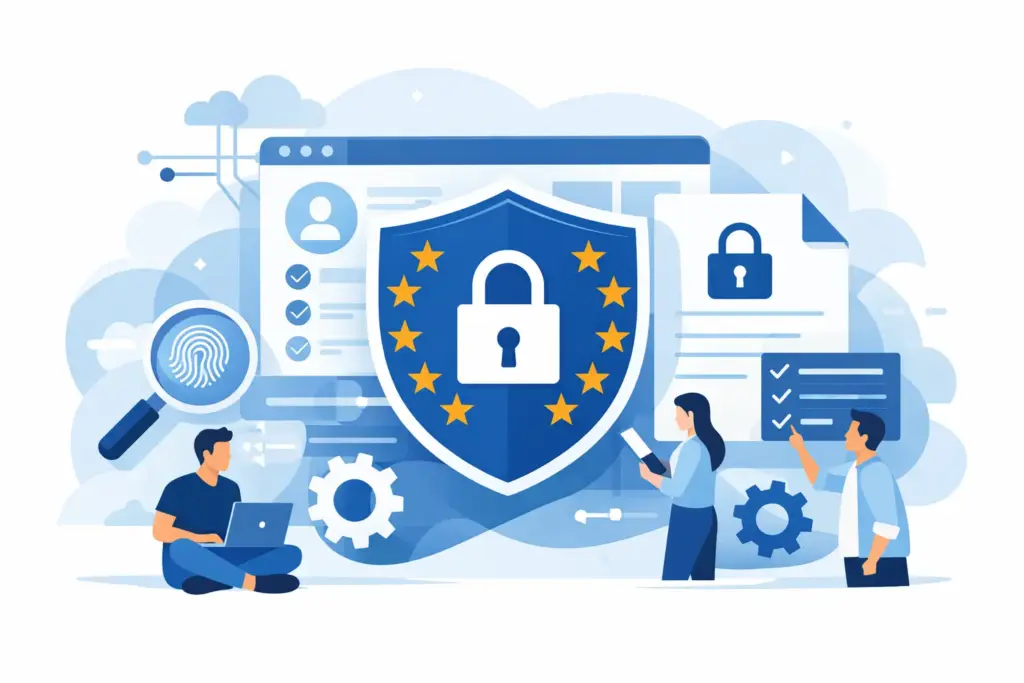
A GDPR compliance program guide is rarely about paperwork first. In technology companies, it starts when sales asks for a security and privacy annex, product wants to launch a new feature in two weeks, and leadership realizes the company needs more than scattered policies to answer basic questions about personal data. That is the moment when GDPR stops being a legal memo and becomes an operating model.
What a GDPR compliance program guide should actually help you do
For a SaaS company, fintech platform, health-tech product, AI provider, or cloud business, GDPR compliance is not a one-time remediation exercise. It is an ongoing system for deciding how data is collected, used, shared, secured, retained, and governed across products, vendors, teams, and markets.
A useful program should help your organization do three things at the same time.
- It should reduce legal and operational risk.
- It should create credible evidence for customers, investors, and regulators.
- It should support product and commercial growth rather than slow it down with unclear approvals and inconsistent controls.
That means the right question is not, “Do we have a privacy policy?” It is, “Can we demonstrate that our data practices are lawful, controlled, and repeatable across the business?”
Start with scope before you start writing documents
Most GDPR programs become inefficient because companies begin with templates instead of scoping. If you do not know which entities, products, data flows, and roles are in scope, your documentation will drift away from reality almost immediately.
Start by identifying where your organization touches EU or UK personal data, whether directly or through enterprise customers, platform integrations, device telemetry, user analytics, employee records, or support operations. For many US-based technology businesses, the practical trigger is not an office in Europe. It is offering services into the EU, monitoring behavior, or processing data on behalf of EU-facing clients.
From there, define which legal roles apply. Some businesses act as controllers for marketing, HR, and product analytics, while acting as processors for customer account data. Others operate in mixed models depending on the feature or service layer. This distinction matters because your obligations, contract positions, notices, and internal controls change with the role.
Build the program around data reality
A GDPR compliance program guide for modern tech companies has to reflect architecture, not just policy language. Data maps and records of processing are foundational, but they only work if they capture the systems where personal data actually moves.
In practice, that usually includes application databases, logging pipelines, support tooling, customer success platforms, CRM environments, cloud infrastructure, collaboration suites, data warehouses, model training datasets, and third-party sub-processors. If your data map ignores engineering and operations realities, it will fail during vendor reviews, audits, incident response, or a data subject request.
This is also where many organizations discover hidden complexity. A company may think it only stores account details, then realize session replay tools, device identifiers, support attachments, test environments, and debugging logs also contain personal data. That does not mean everything must stop. It means the compliance program needs accurate visibility so controls can be applied where they matter.
Governance is where the program becomes durable
Policies are necessary, but governance is what keeps them alive. A practical program assigns ownership across legal, security, product, engineering, HR, and operations instead of leaving the GDPR with one overloaded person.
For smaller businesses, that may mean a lean governance structure with clear decision makers, documented review points, and a defined escalation path. For larger or more regulated organizations, it often means privacy steering committees, formal risk acceptance processes, and control owners tied to recurring reporting.
The appointment question also matters. Depending on your activities, you may need a Data Protection Officer, an EU representative, or both. Some companies do not legally require a DPO but still benefit from a dedicated privacy function because enterprise customers expect mature governance. What matters is not only whether a role exists on paper, but whether it has authority, independence where needed, and operational access to the teams making product and data decisions.
Core controls your program should include
The heart of the program is a set of controls that can be executed consistently. These should be proportionate to your data volumes, risk profile, and technical environment, but several areas are almost always essential.
Lawful basis analysis needs to exist at the processing activity level, not as a generic statement. Privacy notices must align with actual data use. Data processing agreements with vendors and customers should reflect your controller or processor role accurately. Retention rules need to be tied to systems, not just policy text.
You also need workable procedures for handling data subject rights, personal data breaches, international transfers, vendor on boarding, and privacy review for new products or features. In AI, ad tech, IoT, health-tech, and fintech environments, these processes usually need more depth because profiling, sensitive data, automated decision-making, and cross-border infrastructure create elevated risk.
Security is inseparable from GDPR execution. Access control, logging, encryption, vulnerability management, secure development practices, backup governance, and incident response are not separate work streams that happen to help privacy. They are part of how the organization demonstrates appropriate technical and organizational measures.
DPIAs and risk reviews should not be treated as edge cases
Many tech teams only think about Data Protection Impact Assessments when a client asks for one. That is too late. If your company is introducing large-scale monitoring, sensitive data processing, AI-enabled profiling, behavioral analysis, location tracking, or new categories of user analytics, DPIA review should be built into product and change management.
The value of this process is not bureaucratic. It surfaces design issues early, when they are still cheaper to fix. It also gives leadership a structured way to decide whether a use case should proceed as designed, be modified, or be rejected.
There is a trade-off here. Over-engineering assessments can frustrate product teams and create approval bottlenecks. Under-engineering them creates blind spots that appear later in customer diligence, complaints, or incidents. The right balance depends on your product cadence, risk exposure, and internal maturity.
Evidence matters as much as intent
A common weakness in immature programs is that the organization is doing many of the right things but cannot prove it. Regulators, customers, and partners tend to assess maturity through evidence: current records of processing, signed agreements, training logs, incident records, access reviews, retention implementation, assessment outputs, and board-level oversight where appropriate.
This is why the program should be designed with auditability in mind. If an enterprise prospect asks how sub-processors are reviewed, or a supervisory authority asks how you handle deletion requests, you should be able to show a documented process and examples of execution.
For high-growth companies, this discipline has commercial value. Better evidence shortens procurement cycles, improves responses to privacy questionnaires, and reduces friction in strategic deals.
The GDPR compliance program guide for scaling companies
As companies scale, the challenge changes. Early-stage teams usually struggle with basic structure and ownership. Later-stage teams often struggle with fragmentation, where one business unit has mature controls and another is running on exceptions, local habits, or inherited contracts.
A scalable GDPR compliance program guide should account for this. Standardize where consistency matters most, such as vendor reviews, rights handling, breach escalation, transfer assessments, and privacy by design checkpoints. Allow flexibility where business models differ, such as product-specific notices, regional workflows, or different customer contracting structures.
This is one reason specialist support can be valuable in technically complex sectors. In advanced environments, the compliance question is often not just whether a rule applies, but how to implement it across APIs, cloud platforms, machine learning pipelines, distributed teams, and international processing chains without breaking delivery. That is where a hybrid legal, technical, and governance approach becomes more useful than a document-only project.
Common mistakes that weaken the whole program
The first mistake is treating the GDPR as a legal side project. If engineering, security, procurement, and product operations are not part of the program, controls will remain theoretical.
The second is copying a mature-enterprise framework into a company that does not have the headcount to run it. A lightweight program that people actually follow is better than a perfect model no one can operate.
The third is assuming one-time remediation is enough. New vendors, acquisitions, product launches, AI features, and market expansion all change the risk picture. Your program has to move with the business.
The fourth is underestimating international transfer issues. Many US technology companies rely on global infrastructure and support models that create transfer exposure long before anyone has documented it properly.
What good looks like after the first six to twelve months
You know the program is working when privacy questions are answered faster, customer diligence becomes easier, product teams know when to involve compliance, and leadership can see where the main risks sit. You also know it is working when the company can produce evidence without scrambling through inboxes and stale spreadsheets.
Good maturity does not mean zero risk. It means the business understands its processing, has assigned accountability, applies proportionate controls, and can show a credible path for continuous improvement. For many technology organizations, that is the difference between compliance as noise and compliance as operational confidence.
If your organization is building or repairing its approach, keep the program close to real systems, real decisions, and real ownership. That is usually where the GDPR starts becoming manageable, and where it starts supporting the business rather than surprising it.