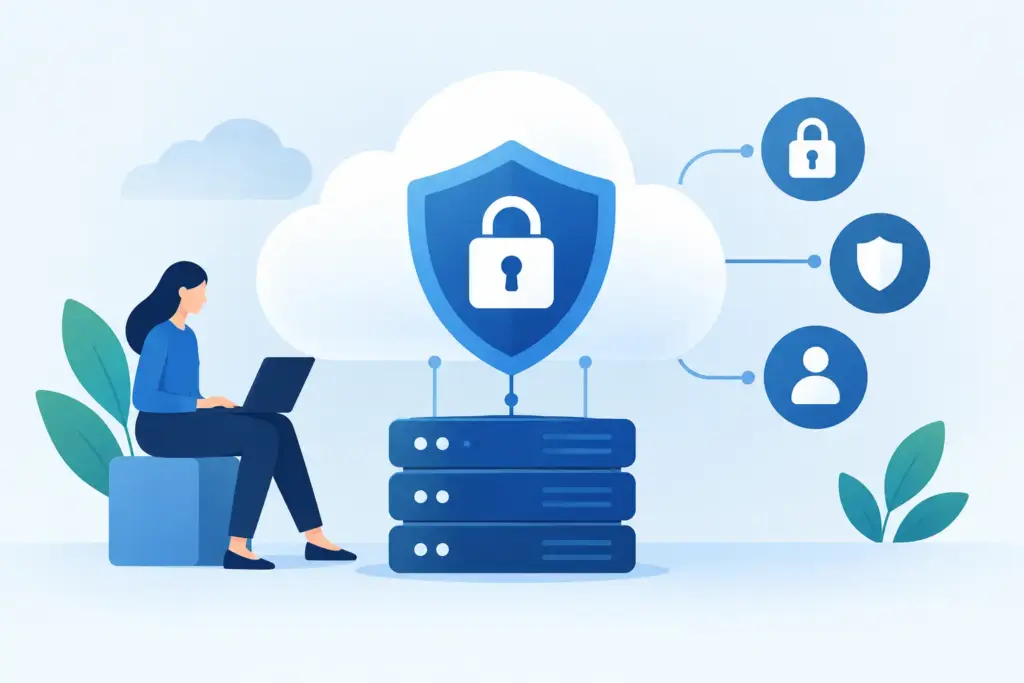
A customer asks where its personal data is stored, who can access it, and how it is deleted. For a cloud-based business, the answer cannot live only in a privacy notice or a policy folder. Cloud infrastructure privacy controls must make that answer provable across accounts, environments, vendors, logs, backups, and day-to-day engineering practices.
For technology companies operating in or serving the EU, this is where GDPR accountability becomes operational. The objective is not to eliminate all cloud risk. It is to design, configure, and govern cloud services so that personal data is processed lawfully, access is constrained, transfers are understood, and teams can produce evidence when customers, regulators, or auditors ask for it.
Privacy control starts with the architecture
Cloud privacy work often starts too late. A team may select a provider, build a data pipeline, and add privacy documentation shortly before launch. By then, data may already be replicated across regions, embedded in logs, available to broad administrator roles, or sent to analytics and support tools without a clear processing purpose.
A more effective approach begins with an architectural data map. This is not merely a register of applications. It should show which categories of personal data enter the environment, where they move, which services store or transform them, how long they remain available, and which parties can receive them. For a SaaS platform, that may include production databases, object storage, observability tooling, customer support platforms, data warehouses, CI/CD logs, backups, and sandbox environments.
The map should distinguish between data that is necessary for the service and data collected for product analytics, marketing, fraud prevention, or model improvement. Those purposes drive different legal, retention, and transparency requirements. They also reveal whether a technical design is collecting more data than the business can justify.
This exercise is particularly valuable in distributed architectures. Microservices, event queues, serverless functions, and managed data products can create copies and derivative datasets quickly. A privacy team cannot assess international transfers, retention, or data subject rights from a single database diagram. It needs a view of the entire processing chain.
The cloud provider does not assume your GDPR duties
The shared responsibility model is often understood as a security concept, but it has direct privacy implications. A cloud provider may secure the physical infrastructure and offer encryption, regional hosting, identity tools, and audit logs. The customer still decides which services to enable, who receives access, what data is uploaded, how it is classified, and how long it is retained.
The contractual position matters as well. Organizations should determine whether each provider acts as a processor, a subprocessor, an independent controller, or in a mixed role for particular service features. Standard terms are not enough on their own. The organization must understand subprocessors, support access, transfer mechanisms, government access terms, deletion commitments, and the practical configuration options that affect those commitments.
This is especially relevant where teams activate optional AI, telemetry, threat-detection, or managed support features. Such features can improve operations, but may also expand data flows or introduce new processing purposes. The right choice depends on the data involved, the customer contract, and the available safeguards. Privacy review should therefore be part of service onboarding and major configuration changes, not a one-time procurement task.
Core cloud infrastructure privacy controls
Effective controls combine technical enforcement with clear ownership. The following areas are usually central to a defensible cloud privacy program:
- Data classification and discovery: Tag or otherwise identify personal data, sensitive data, production data, and datasets subject to heightened contractual or regulatory requirements. Discovery tools can help locate unexpected personal data in storage, logs, and collaboration environments, but findings need a named owner and remediation process.
- Identity and access management: Apply least-privilege access, role-based permissions, strong authentication, privileged-access workflows, and periodic access reviews. Separate production access from development work wherever possible, and avoid shared administrator accounts that make accountability difficult.
- Encryption and key governance: Encrypt data in transit and at rest, then define who controls keys, who can use them, how access is logged, and when keys are rotated. Customer-managed keys can strengthen control in certain cases, but they also create operational responsibility. A lost or poorly managed key is not a privacy safeguard.
- Retention, deletion, and backup design: Configure lifecycle policies that match approved retention periods. Deletion should address primary systems, replicated stores, backups, and data held by vendors. It is acceptable for backups to follow a controlled deletion cycle, but the organization must be able to explain the cycle and ensure restored data does not reintroduce expired records into active use.
These controls are not independent. A retention rule has limited value if a broad service role can export data indefinitely. Encryption does not compensate for an environment where credentials are embedded in code repositories. Privacy risk decreases when controls reinforce each other and are tested in real operating conditions.
Privacy by design means controlling the nonproduction problem
Development, testing, and incident investigation are common sources of unnecessary exposure. Engineers need realistic data to diagnose issues, but copying production databases into lower environments can create a larger access population and weaker controls than the production system itself.
Use synthetic, masked, anonymized, or carefully pseudonymized data where feasible. The correct method depends on the use case. Simple masking may not prevent re-identification if linked datasets or stable identifiers remain available. Pseudonymized data remains personal data under GDPR and should continue to receive appropriate protection. Anonymization requires a higher standard and should be assessed against the realistic means of re-identification, not simply the removal of names.
Logging deserves equal attention. Application logs, error traces, and monitoring events often capture email addresses, IP addresses, account IDs, tokens, request payloads, or health data. Define what may be logged, scrub sensitive fields before transmission, limit log access, and set retention periods that reflect the purpose of diagnostics. Security teams need visibility, but they do not need unrestricted access to every customer record to investigate every event.
Regional design and international data transfers
Choosing an EU cloud region is a useful technical measure, but it does not automatically resolve international transfer questions. Data can leave a region through remote support, centralized administration, threat intelligence services, monitoring tools, subprocessors, or replicated backups. The relevant question is not only where a workload runs, but who can access the data and from where.
A transfer assessment should connect the legal mechanism to the actual architecture. Identify transfers, document the roles of each party, assess applicable safeguards, and verify that technical and organizational measures align with the risk. Encryption, access restrictions, pseudonymization, and contractual commitments may all play a role, but their value depends on implementation. For example, encryption offers less protection against foreign access if the same party can readily access the keys.
For global SaaS and fintech businesses, regional segmentation may also be commercially valuable. It can support enterprise customer requirements, reduce latency, and provide clearer boundaries for operational teams. However, multiple regions increase complexity. The business must plan for consistent retention, access, incident response, and rights-handling processes across each environment.
Make privacy controls observable and testable
A control that cannot be evidenced is difficult to rely on during an audit, customer review, or incident. Technical teams should produce usable evidence from normal operations: access review records, configuration baselines, data flow diagrams, deletion reports, encryption settings, vendor assessments, and security monitoring outputs.
Automation can reduce drift. Policy-as-code, infrastructure templates, configuration monitoring, and deployment checks can prevent teams from exposing storage, disabling logging, or creating resources outside approved regions. Yet automation is not a substitute for governance. Exceptions will occur, particularly in product launches, acquisitions, and incident response. Each exception needs a documented risk decision, compensating measures, an owner, and an expiration date.
Testing should reflect likely failure modes. Can an employee with standard support access retrieve production records? Does a deleted account remain in an analytics table? Can a data subject access request be fulfilled across active systems? Does a restored backup restore data that should no longer be processed? These questions turn abstract compliance claims into practical assurance.
Assign ownership before an incident forces the issue
Cloud privacy is shared across legal, product, security, engineering, procurement, and operations. Without clear ownership, teams may assume someone else has approved a vendor, configured a retention policy, or reviewed a new data export. A privacy governance model should identify decision makers, required review points, technical control owners, and escalation routes.
For higher-risk processing, a Data Protection Impact Assessment can provide the structure needed to assess necessity, proportionality, risk, and mitigations before implementation. This is particularly relevant for large-scale monitoring, sensitive data, AI-enabled profiling, connected devices, and new uses of behavioral or location data. The assessment should be informed by the real design, not completed as a generic legal questionnaire after the architecture is fixed.
The strongest cloud privacy programs make compliant behavior the easier path for delivery teams. Approved patterns, reusable infrastructure modules, clear vendor intake, and practical engineering guidance reduce friction while preserving accountability. That is how organizations build the confidence to scale cloud services, meet demanding customer expectations, and demonstrate that privacy commitments are being enforced where personal data actually lives.