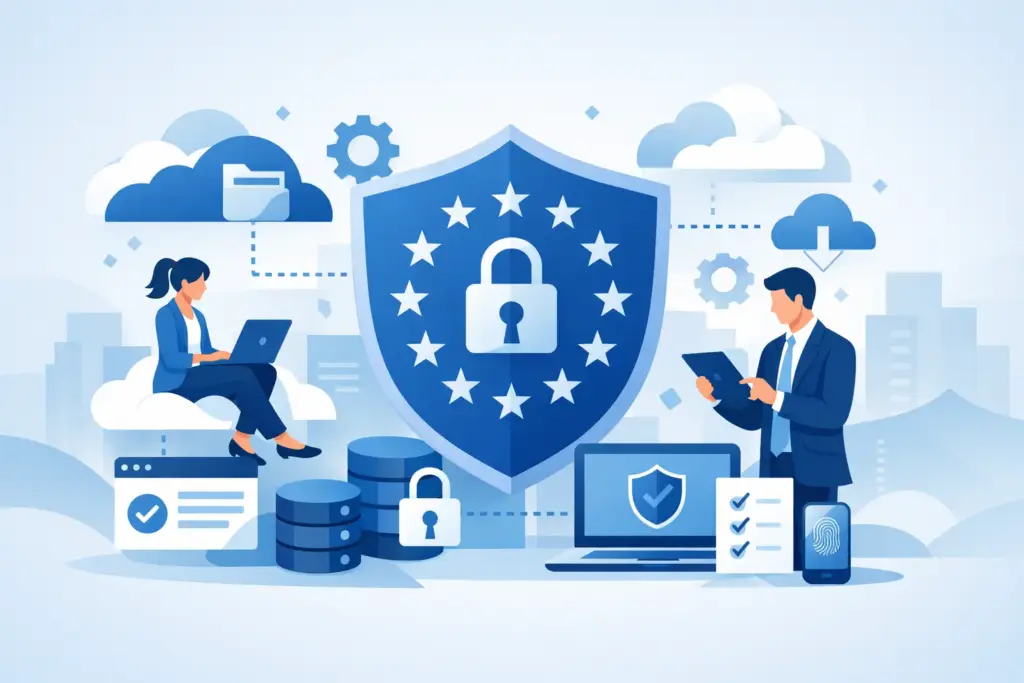
A customer’s security questionnaire lands in your inbox with a familiar line: explain your GDPR posture, identify your role, describe subprocessors, and confirm lawful transfer mechanisms. For many teams, that single request exposes a larger issue. GDPR compliance for SaaS companies is rarely just a legal documentation exercise. It reaches into product design, analytics, customer support, security operations, vendor management, and go-to-market commitments.
That is why SaaS businesses often get stuck. The regulation sounds principle-based, but customers, regulators, and procurement teams expect evidence, not intent. If your platform serves EU users, supports EU-based customers, or monitors behavior in the EU, you need a compliance model that fits how your product actually works.
What GDPR compliance for SaaS companies really involves
SaaS companies process personal data in ways that are continuous, distributed, and hard to isolate. Data flows through application logs, support tickets, telemetry, billing systems, CRM tools, identity providers, and cloud infrastructure. In many cases, engineering teams add processors or new use cases faster than legal and compliance functions can document them.
That complexity matters because GDPR is not limited to the customer database. Personal data includes user identifiers, device data, employee account information, chat records, IP addresses, and behavioral analytics when those data points relate to an identifiable person. For a SaaS company, compliance means understanding the full processing ecosystem, then putting governance and technical controls around it.
A second layer of complexity is role allocation. Many SaaS providers assume they are always processors, but that is often too simplistic. You may act as a processor for customer account data while acting as a controller for marketing, prospecting, account administration, fraud prevention, or product analytics. If your role changes by dataset or purpose, your contracts, notices, and internal governance need to reflect that.
Start with data flows, not paperwork
The fastest way to create weak GDPR documentation is to draft policies before mapping the product. For SaaS businesses, the practical starting point is a structured data inventory tied to real systems and purposes. You need to know what personal data you collect, where it is stored, who can access it, why it is processed, how long it is retained, and which vendors are involved.
This exercise should include production systems, testing environments, logs, backups, internal admin tools, and support workflows. It should also distinguish between optional and necessary processing. Many SaaS platforms accumulate personal data simply because telemetry defaults were enabled or old features were never retired. Those choices create exposure without always adding business value.
Once the map is clear, GDPR decisions become easier. You can identify lawful bases, define controller versus processor roles, document international transfers, and spot areas where privacy by design has not kept pace with product growth.
Contracts and role clarity are where many SaaS deals are won or lost
Enterprise customers now review privacy terms with much more discipline. If your Data Processing Agreement is generic, inconsistent with your architecture, or silent on key subprocessing details, procurement slows down and trust drops.
For most SaaS companies, the DPA should align with how the service is actually delivered. That includes the processing subject matter, categories of data, categories of data subjects, technical and organizational measures, subprocessors, assistance obligations, deletion or return language, and audit mechanisms. Overpromising here creates avoidable risk. Under-describing your controls creates commercial friction.
Role clarity matters just as much. If you decide purposes and means for certain datasets, calling yourself a processor across the board will not fix the issue. A more defensible approach is to explain the split clearly and support it with transparent notices and contractual language. Sophisticated customers generally accept nuanced positions when they are well reasoned and operationally consistent.
Product design decisions can create or reduce GDPR risk
The most effective GDPR programs for SaaS companies are built into the product lifecycle. That means product, engineering, security, and legal teams need a shared process for reviewing new features that affect personal data.
Consider common examples. Session replay tools may capture more than intended. AI features may process user-generated content in ways customers did not expect. Admin panels may expose excessive user data to internal teams. Logging may retain identifiers longer than necessary. None of these issues are unusual, but each changes the compliance picture.
This is where privacy by design becomes practical rather than theoretical. Teams should ask whether the feature needs the data, whether the same outcome can be achieved with less data, whether access can be segmented, and whether retention can be reduced. For higher-risk use cases, a Data Protection Impact Assessment may be required, especially where profiling, large-scale monitoring, or sensitive data is involved.
International transfers remain a core issue for US-based SaaS businesses
Many US SaaS companies rely on global cloud infrastructure, distributed support teams, and US-based operational functions. If EU personal data is accessed or transferred outside Europe, transfer rules need to be addressed explicitly.
For most organizations, that means assessing whether the transfer relies on an adequacy mechanism, Standard Contractual Clauses, or another valid route. But paperwork alone is not enough. The legal mechanism should be backed by a practical transfer assessment that considers the data involved, the destination, the recipients, encryption, access controls, and the real-world likelihood of government access or onward disclosure.
This is an area where generic compliance advice often breaks down. Transfer analysis for a simple marketing stack is one thing. Transfer analysis for a multi-tenant SaaS platform with support tooling, cloud hosting, observability services, and engineering access paths is another. The right answer depends on architecture, not just templates.
Security and GDPR are connected, but they are not interchangeable
Many SaaS leaders assume that a strong security program means they are close to GDPR compliance. It helps, but it does not solve the full problem. GDPR requires appropriate security measures, yet it also requires lawful processing, transparency, data subject rights handling, retention governance, processor oversight, and accountability documentation.
That said, security maturity is one of the clearest indicators of GDPR readiness in a SaaS environment. Access control, encryption, vulnerability management, logging discipline, incident response, secure development, and vendor review all matter. They matter not just because Article 32 exists, but because weak operational security makes every other compliance representation harder to defend.
The trade-off is that not every control needs the same level of investment on day one. A growth-stage SaaS company does not need the same formalization as a large regulated enterprise, but it does need a documented, risk-based rationale for its control environment. Regulators and enterprise buyers are usually more interested in coherent governance than in inflated claims.
Data subject rights need operational handling, not inbox theater
One of the clearest signs of weak GDPR maturity is when subject rights requests are handled manually with no system support. Access, deletion, rectification, restriction, and objection rights all require process discipline. In SaaS, that can be complicated by multi-tenant architectures and customer-controlled environments.
The first question is whose request it is. If the data belongs to your customer’s end users and you act as processor, the customer usually leads. But your platform still needs the capability to support the request within contractual and legal timelines. If the request concerns your own controller data, such as marketing or account administration records, you need internal workflows to verify identity, locate the data, respond appropriately, and maintain an audit trail.
Deletion is a good example of where technical reality matters. Immediate erasure from every system may not always be feasible because of backups, legal holds, fraud controls, or service continuity requirements. GDPR allows nuance here, but only if your retention logic is documented, limited, and transparent.
Governance is what keeps compliance from drifting
A surprising number of SaaS companies complete an initial GDPR project, then lose control six months later. New vendors are added without review. Product changes alter processing purposes. Notices go stale. Security controls evolve faster than compliance records. The result is a polished external posture sitting on top of outdated internal assumptions.
Sustainable GDPR compliance for SaaS companies depends on governance that matches the speed of the business. That usually means defined ownership, periodic control reviews, vendor onboarding checks, feature review gates, training for relevant teams, and a process for escalating higher-risk changes. For some companies, outsourced DPO support or managed compliance oversight is the most efficient way to maintain that discipline.
This is especially true in high-growth or technically complex environments, where legal, engineering, and commercial teams need a common operating model rather than fragmented advice. TechGDPR often sees the strongest outcomes where compliance is treated as an ongoing business function tied to product and customer trust, not as a one-time legal project.
The practical goal is not perfection. It is being able to explain, evidence, and improve how your SaaS business handles personal data as the company grows. That is what gives customers confidence, supports EU market access, and makes regulatory scrutiny far less disruptive when it arrives.