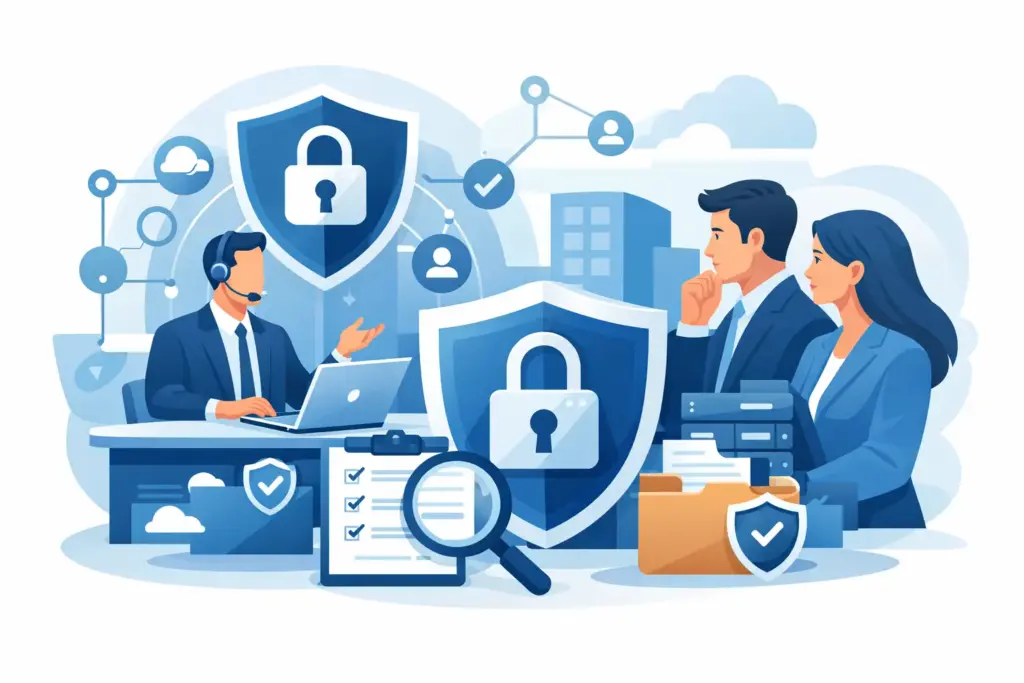
A privacy program usually starts showing strain at the same moment the business starts growing up. Sales wants enterprise customers, product teams are shipping faster, security is fielding deeper diligence requests, and legal is being asked whether the company needs a DPO at all. That is where outsourced data protection officer services become a practical option, especially for technology companies that need credible GDPR oversight without adding a full-time senior hire too early.
For many organizations, the question is not whether privacy oversight matters. It is whether they need that oversight in-house, how independent it must be, and whether the person advising on GDPR can actually understand the architecture, vendors, data flows, and product decisions that create risk. In high-growth SaaS, fintech, AI, health-tech, cloud, and platform businesses, those details matter more than broad policy language.
What outsourced data protection officer services actually provide
At a minimum, outsourced data protection officer services are designed to fulfill the DPO function under GDPR where the regulation requires one, or where a company chooses to appoint one as a matter of governance. That includes advising on data protection obligations, monitoring compliance, supporting data protection impact assessments, cooperating with supervisory authorities, and serving as a contact point for regulators and data subjects where appropriate.
In practice, the scope is often broader. A capable outsourced DPO does not operate as a passive mailbox for privacy questions. The role usually sits at the intersection of legal interpretation, operational controls, technical understanding, and internal accountability. That can mean reviewing product changes for privacy impact, challenging weak retention logic, helping define lawful bases, shaping records of processing, and aligning privacy expectations with security and procurement workflows.
The difference between a paper DPO and a useful DPO is execution. Many businesses do not need another policy deck. They need someone who can assess whether telemetry practices match the privacy notice, whether engineering can actually honor deletion requests, and whether cross-border processing assumptions will hold up in customer diligence or regulatory review.
When outsourcing the DPO role makes sense
Outsourcing is often the right fit when the company has meaningful GDPR exposure but does not yet need, or cannot yet justify, a full-time internal DPO. That is common in venture-backed technology companies entering EU markets, US businesses with growing European customer bases, or scale-ups handling sensitive or high-volume personal data across multiple products and vendors.
It also makes sense when the internal team has ownership gaps. Sometimes legal is capable but stretched. Sometimes security is mature but not positioned to interpret data protection rules. Sometimes operations is carrying privacy administration without strategic direction. An outsourced DPO can provide structure and independence without requiring a complete reorganization.
There is also a governance reason. The DPO role under GDPR is supposed to have a degree of independence and should not be placed in a position with conflicting interests. That creates a challenge if the most privacy-aware people in the company are also the ones making decisions about product design, monetization, or risk acceptance. Outsourcing can help create clearer separation.
The case for outsourced data protection officer services in tech environments
Technology companies rarely process personal data in simple ways. They operate multi-tenant environments, rely on layered subprocessors, collect detailed event logs, use AI models or analytics tooling, and launch features that change data processing faster than governance can catch up. A generic DPO service may satisfy a formal checkbox, but it often struggles once the conversation moves from legal theory to actual systems.
That is why technical fluency matters. A DPO advising a cloud platform, digital health product, blockchain business, or AI-enabled SaaS provider needs to understand more than GDPR articles. They need to grasp the difference between controller and processor functions across a product stack, the compliance consequences of training data reuse, the privacy impact of observability tooling, and the operational limits of deleting data from complex infrastructure.
This is also where customers notice the difference. Enterprise buyers increasingly ask detailed privacy and security questions during procurement. They want to know who owns privacy governance, how DPIAs are handled, whether transfers have been assessed, and whether the company can explain its data lifecycle with confidence. An outsourced DPO who understands the environment can support those conversations in a way that builds trust rather than slowing deals.
What good outsourced DPO support looks like
A strong outsourced DPO arrangement should feel embedded, not distant. The provider should understand the business model, product architecture, vendor footprint, processing purposes, and risk profile. Without that context, advice will be generic and often too cautious or too shallow to be useful.
The service should also be calibrated to the company’s maturity. An early-stage SaaS business may need foundational governance, clearer accountability, practical records of processing, and help establishing incident and rights-request workflows. A later-stage fintech or health-tech company may need more advanced oversight tied to DPIAs, international transfers, sensitive data processing, customer audits, and regulator-facing documentation.
Responsiveness matters as much as expertise. Privacy decisions often sit inside product launches, contracting cycles, and security reviews that move on real deadlines. If the outsourced DPO cannot engage quickly with internal stakeholders, the role will become ceremonial. The best arrangements provide both strategic oversight and hands-on support where the business actually needs it.
Common misconceptions and trade-offs
One misconception is that outsourced means lighter-touch by definition. It can, but it does not have to. A well-structured external DPO service can provide more consistent oversight than an internal appointment made on paper and left unsupported.
Another misconception is that every company subject to GDPR needs a DPO. That is not always true. Whether a DPO is mandatory depends on the nature of the processing and the organization’s activities. Some companies benefit from privacy leadership without formally appointing a DPO. Others clearly need the role and should not try to stretch a general counsel, security lead, or operations manager into it.
There are trade-offs. An external DPO will need deliberate onboarding, regular access to stakeholders, and visibility into incidents, vendor changes, and product developments. If leadership treats the provider as someone to consult only after decisions are made, the value drops sharply. Outsourcing is not a substitute for internal ownership. It works best when there is a committed internal contact structure and a culture of escalation.
Cost is another factor, but it should be viewed against realistic alternatives. A senior in-house hire with sufficient GDPR depth, technical understanding, and independence can be expensive and difficult to recruit. For many companies, outsourced data protection officer services provide a more proportionate way to access that level of expertise while matching support to actual need.
How to evaluate a provider
Start with substance, not branding. Ask whether the provider has experience with businesses like yours, including your data model, sector, and regulatory profile. If your company works in AI, financial services, digital health, blockchain, or cloud infrastructure, the DPO should be able to discuss the operational privacy issues that come with those environments.
Next, examine delivery. Who will actually perform the DPO role? How is independence maintained? What is the escalation path for incidents or regulator contact? How often will they review compliance posture, and what outputs should your team expect? A credible service should be able to explain how it supports day-to-day governance, not just annual review cycles.
Then look at integration. The right provider should be comfortable working across legal, engineering, product, security, procurement, and leadership teams. Privacy risk does not sit neatly in one department, and DPO support fails when it is isolated from operational decision-making.
For complex technology companies, a specialist advisor such as TechGDPR can add value because the work is not limited to interpreting GDPR in the abstract. It involves translating regulation into controls, documentation, product governance, and evidence that stands up to customer scrutiny.
A practical model for growing companies
For many businesses, the most effective approach is a hybrid one. The outsourced DPO provides formal oversight, senior guidance, and external independence, while internal teams own implementation in their functions. Product handles design changes, security manages technical safeguards, legal supports contractual positions, and operations keep workflows moving. The DPO coordinates, challenges, and advises across that structure.
That model tends to scale better than treating privacy as a stand-alone legal task. It allows the organization to mature its governance without overbuilding too early. It also creates a clearer path for moving from reactive issue handling to a more stable compliance program.
If your company is processing significant personal data, expanding in Europe, or facing heavier diligence from customers and partners, outsourced data protection officer services are not just a way to fill a role. They can be the mechanism that turns privacy from a recurring source of uncertainty into a managed business function. The right support gives teams confidence to move faster because the governance behind them is credible, informed, and operationally real.