A DPO decision usually shows up when the stakes are already high. A customer asks who holds the privacy function. A regulator-facing process needs clear ownership. A fast-growing product team starts launching into new EU markets, and suddenly the question is not whether privacy needs leadership, but what kind.
That is where the outsourced dpo vs internal dpo debate becomes practical rather than theoretical. For technology companies, the right answer depends less on preference and more on operating model, risk profile, technical complexity, and the level of day-to-day execution the business actually needs.
What the DPO role is supposed to do
Under the GDPR, the Data Protection Officer role is not a symbolic appointment. The DPO is expected to inform and advise the organization on its obligations, monitor compliance, support data protection impact assessments, cooperate with supervisory authorities, and act as a contact point for regulators and data subjects where appropriate.
Just as important, the role has structural requirements. A DPO needs sufficient expertise, access to senior management, and a level of independence. The role also cannot be shaped around conflicting interests. That matters because many businesses initially assume they can simply assign the function to legal, security, or operations leadership without considering whether the person is also making decisions about the purposes and means of processing.
For a technology business, this is rarely just a paperwork issue. Privacy questions often sit inside product design, cloud architecture, vendor ecosystems, AI workflows, security response, and international data transfers. A DPO needs to work across those realities, not above them.
Outsourced DPO vs internal DPO: the real difference
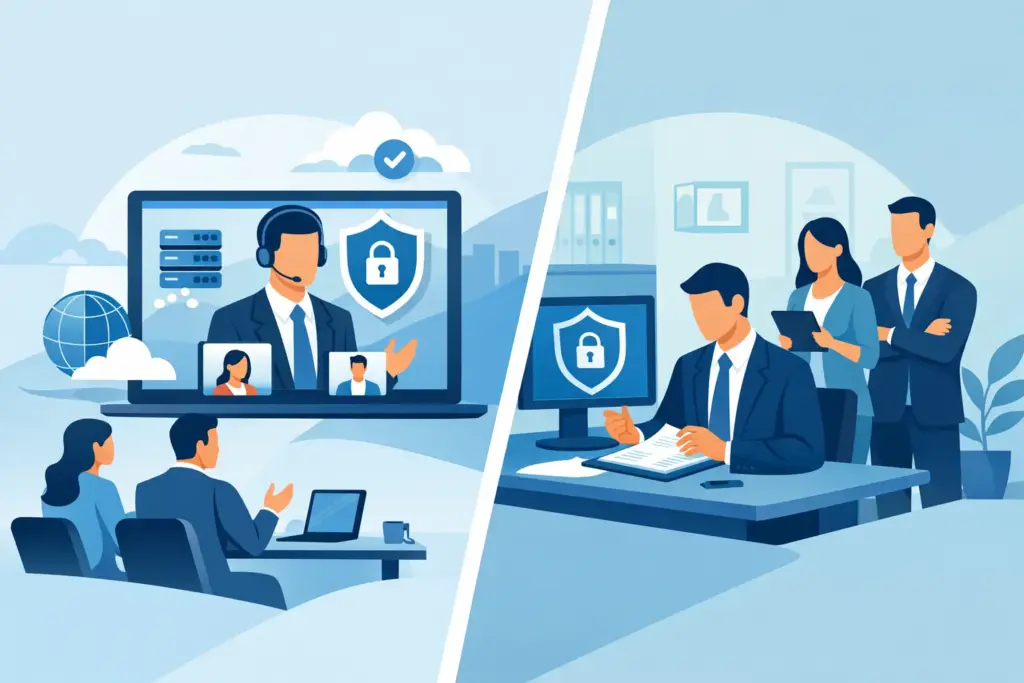
The headline difference is simple. An internal DPO is an employee inside the business. An outsourced DPO is an external specialist or specialist firm formally appointed to perform the role.
In practice, the difference runs deeper. An internal DPO brings embedded organizational context, direct access to teams, and often more day-to-day visibility into internal decision-making. An outsourced DPO brings independence, a wider range of cross-sector regulatory experience, and usually a more scalable support model.
Neither option is automatically better. The more useful question is what type of DPO setup will perform credibly under scrutiny while still helping the business move.
When an internal DPO makes sense
An internal DPO can work well in larger organizations with mature governance structures, stable processing environments, and enough scale to justify a dedicated senior privacy hire. If the company has multiple jurisdictions, complex data operations, and a constant stream of internal initiatives, a strong in-house DPO may provide continuity that is hard to replicate.
This model is especially effective when privacy is already integrated into product, legal, procurement, and security processes. In that environment, an internal DPO can build strong internal influence, understand the politics behind decisions, and intervene early before design or procurement choices create compliance problems.
There is also a credibility advantage in some organizations. Employees know where to go, business stakeholders have a visible owner, and privacy governance can feel less externalized.
The difficulty is that a qualified internal DPO is rarely a simple hire. The person needs GDPR fluency, practical governance judgment, communication skills, and enough technical understanding to assess how data actually moves through systems. In sectors like AI, fintech, health-tech, SaaS, or cloud infrastructure, that combination is uncommon and expensive.
Then there is independence. A senior internal candidate may already hold a role that creates conflict. If the same person defines product strategy, leads security operations, or controls key processing decisions, appointing them as DPO may create a structural problem from the start.
When an outsourced DPO makes sense
An outsourced DPO is often the stronger option for startups, scale-ups, and mid-market technology companies that need serious GDPR capability but do not need, or cannot justify, a full-time senior internal appointment.
This model gives the company access to specialist expertise without tying the role to a single employee profile. A good outsourced DPO arrangement can combine legal interpretation, operational compliance support, regulatory communication, and technical awareness in a way that one internal hire may not.
That matters in high-change environments. If your business is launching new features, entering the EU, integrating new vendors, building AI use cases, or responding to enterprise customer diligence, privacy oversight needs to keep up with product and commercial velocity.
An outsourced DPO can also be easier to defend from an independence perspective. Because the provider is external, there is less risk that the role is compromised by internal reporting lines or business ownership decisions. For organizations that have struggled to identify a conflict-free internal candidate, this is often decisive.
The trade-off is proximity. Even a highly engaged outsourced DPO will not automatically absorb internal context the way an employee does. The relationship only works well when governance is structured properly, stakeholders know when to involve the DPO, and the provider has access to the right people, documentation, and systems.
Cost is only one part of the decision
Many companies frame outsourced dpo vs internal dpo as a budget question. Cost matters, but on its own it can be misleading.
An internal DPO means salary, benefits, hiring costs, management overhead, training, and retention risk. If the business needs a genuinely senior hire with both regulatory and technical competence, the total investment can be substantial. If that person leaves, the gap is immediate.
An outsourced DPO usually offers more predictable cost control. The business pays for a defined service model and can often scale support based on actual need. For companies that need access to specialist input across DPIAs, vendor reviews, incident support, governance documentation, and regulator interaction, this can be more efficient than hiring one person and expecting them to cover every domain.
Still, the cheapest model is not always the safest one. If the business needs daily embedded support and constant internal coordination, an under-scoped outsourced arrangement may create friction. If the company appoints an internal DPO without enough expertise or time, the role may exist on paper but fail in practice.
Expertise, coverage, and business reality
This is where the decision often becomes clearer.
An internal DPO offers depth in one organization. An outsourced DPO typically offers pattern recognition from many organizations, sectors, and regulatory scenarios. For companies dealing with cross-border transfers, AI governance, complex processor chains, product analytics, sensitive data, or security compliance overlap, that broader experience can be valuable.
The strongest outsourced models also reduce single-person dependency. Instead of relying entirely on one employee, the company can benefit from a team structure with complementary legal, governance, and technical skills. That is particularly useful when issues move beyond basic GDPR administration and into architecture, vendor ecosystems, incident response, or accountability evidence.
By contrast, an internal DPO can be highly effective if the company already has supporting specialists around them. A privacy-savvy legal team, strong security leadership, disciplined engineering governance, and clear escalation channels can make an internal model work exceptionally well.
So the question is not which model sounds more mature. It is whether your current organization can support the one you choose.
How to choose between outsourced and internal DPO models
Start with the processing reality, not the org chart. Look at the sensitivity of your data, the scale of processing, the number of jurisdictions involved, and how often product or operational change creates privacy impact.
Then assess independence honestly. If your likely internal candidate owns decisions about data use, platform design, security controls, or commercial operations, there may be a conflict that weakens the appointment.
Next, look at capacity. Do you need strategic oversight only, or regular operational involvement across DPIAs, records of processing, data subject rights, vendor reviews, customer diligence, and internal training? A role that is too narrowly scoped tends to fail quietly.
Finally, consider credibility. If a regulator, enterprise customer, investor, or board member asked how your DPO function is supported, resourced, and kept independent, would the answer stand up well?
For many technology businesses, a specialist outsourced model is the more practical and defensible choice, especially where privacy needs to keep pace with technical complexity. Firms such as TechGDPR are often brought in precisely because the challenge is not only GDPR interpretation, but applying it inside modern product and infrastructure environments.
A hybrid path can also work
Some organizations do not need to choose one model forever. An outsourced DPO can support a period of rapid growth, regulatory remediation, or EU market entry, then help transition to an internal appointment later. In other cases, the company keeps an internal privacy lead while formally appointing an external DPO to preserve independence and widen specialist coverage.
That kind of model can work well when the business wants internal coordination without overloading one employee with every regulatory and operational demand.
The best DPO setup is the one that can challenge the business when needed, support teams without slowing them down, and hold up under external scrutiny. If your business is building in complex data environments, that standard matters more than whether the role sits inside the company or outside it.