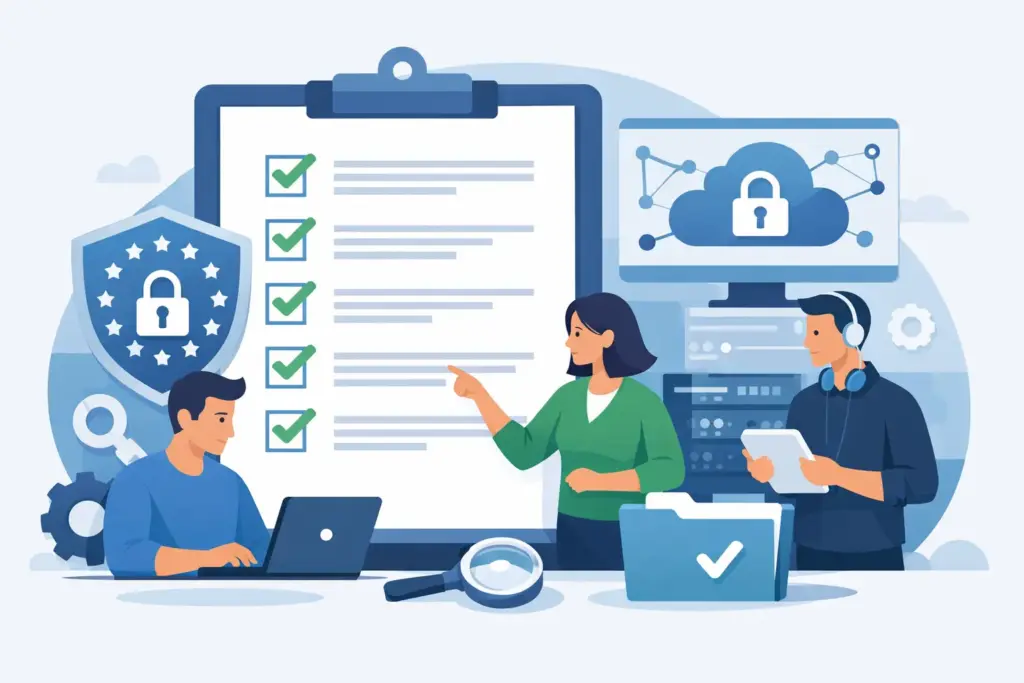
A customer procurement questionnaire, an enterprise security review, or a planned EU launch often exposes the same problem: the company has privacy policies, but cannot show how personal data actually moves through its product. This GDPR readiness checklist guide is designed for technology teams that need to turn high-level obligations into evidence that stands up to customer, regulator, and investor scrutiny.
GDPR readiness is not a document collection exercise. For SaaS, AI, cloud, fintech, blockchain, and health-tech businesses, it is an operating model question. Product architecture, telemetry, support tooling, identity systems, model training, vendor contracts, and incident response must align with a defensible view of who processes what data, for which purpose, and under whose authority.
Start With Scope, Roles, and Accountability
Begin by defining which legal entities, products, markets, and processing environments are in scope. A US company with no EU office can still be subject to the GDPR if it offers goods or services to people in the EU or monitors their behavior. This assessment should be recorded, rather than assumed, because it informs decisions on representation, lead supervisory authority, contractual controls, and governance.
Next, establish whether the organization acts as a controller, processor, or both for each processing activity. A B2B SaaS provider may be a processor for customer account data, but an independent controller for website analytics, sales leads, product usage analytics, security logging, and billing contacts. These distinctions determine which notices, contracts, instructions, and data subject processes are required.
Accountability also needs an owner. Assign clear responsibility for privacy governance across legal, security, engineering, product, and operations. Depending on the nature and scale of processing, appointing a Data Protection Officer may be mandatory or commercially prudent. Organizations without an EU establishment may also need an EU Article 27 representative. Neither role is a substitute for internal ownership, but both can provide structure and reliable escalation paths.
Build a Defensible Data Inventory
A credible GDPR program starts with a living data map (sometimes Records of Processing Activities, RoPA) which is not a spreadsheet created for one audit. Document personal data collected across the customer lifecycle: trial sign-ups, production use, mobile applications, cookies, support tickets, payment flows, sales systems, recruiting, and employee administration.
For every material data flow, capture the categories of individuals and data, the source, purpose, lawful basis, receiving systems, storage location, recipients, retention period, and security controls. Include data that is easy to overlook, such as IP addresses, device identifiers, application logs, session recordings, pseudonymous user IDs, free-text support requests, and backups.
Technical depth matters here. In modern architectures, personal data may pass through event pipelines, observability platforms, CDNs, feature flag tools, error monitoring, data warehouses, and AI service providers before it reaches a core application database. A diagram that stops at the production environment is usually insufficient. Engineering and security teams should validate the map against actual configurations, service accounts, API integrations, and subprocessors.
The resulting inventory supports the Article 30 record of processing activities. It also gives teams the factual basis to answer security questionnaires, respond to access requests, assess international transfers, and identify processing that should be reduced or redesigned.
Test Lawful Bases and Purpose Boundaries
Every processing purpose requires an appropriate lawful basis. For many business-to-business technology services, contract performance, legitimate interests, legal obligation, and consent may all apply in different contexts. The common failure is relying on a broad statement such as legitimate interest without documenting the specific purpose, necessity, balancing assessment, and safeguards.
Review whether data collection is necessary for the stated product function. Product teams should be able to explain why each field, event, or identifier is collected and whether a less intrusive alternative exists. If consent is relied upon, it must be informed, specific, freely given, and as easy to withdraw as it was to provide. Consent obtained through a bundled onboarding flow or a pre-checked preference is unlikely to provide the assurance a high-growth technology company needs.
Purpose limitation deserves particular attention in AI and analytics programs. Data collected to provide a customer service cannot automatically be reused for model training, behavioral profiling, or product benchmarking. The answer depends on contractual promises, data roles, expectations of individuals, the nature of the data, and technical measures such as aggregation or effective anonymization.
Make Privacy Notices Match the Product
Privacy notices should describe processing that exists in practice, using language a customer or user can understand. Compare public notices, employee notices, cookie notices, and customer-facing data processing terms against the data inventory. Mismatches are a useful signal that governance has fallen behind product development.
A mature notice program explains the relevant purposes, lawful bases, recipients, transfer mechanisms, retention criteria, individual rights, and contact points. It should also distinguish the organization’s own controller activities from processing carried out on behalf of enterprise customers. Generic language may be tempting during rapid growth, but it creates risk when a user asks a detailed question or a buyer compares public claims with a security assessment.
Put Data Subject Rights Into an Operational Workflow
Rights requests need more than a shared inbox. Establish a documented workflow for access, deletion, correction, portability, restriction, objection, and consent withdrawal. Define how requests are authenticated, tracked, assigned, completed, and escalated within the GDPR time limit.
The practical challenge is locating data across distributed systems. Test the workflow with a realistic request that touches production data, CRM records, support systems, analytics, backups, and vendor-hosted tools. A deletion request may not require immediate deletion from immutable security logs or backups where retention is justified, but the organization should be able to explain the exception, restrict future use where appropriate, and ensure eventual deletion.
For processor activities, ensure the customer contract sets out how assistance will be provided. This is especially relevant where the customer controls response decisions but the provider holds the technical ability to search, export, or erase data.
Review Vendors, Contracts, and International Transfers
A GDPR readiness checklist guide should examine the entire supplier chain, not only the primary cloud provider. Maintain a vendor register that identifies processing purpose, data categories, hosting locations, subprocessor status, contractual terms, security assurance, retention, and transfer arrangements.
Processor agreements must contain the required GDPR terms, including documented instructions, confidentiality, security, subprocessor controls, assistance, deletion or return provisions, and audit information. Commercial teams should understand that a signed data processing agreement alone does not cure an unmanaged vendor relationship. The technical and operational reality must match the contract.
For transfers outside the European Economic Area, identify the transfer mechanism and assess whether supplementary measures are needed. Standard contractual clauses are often part of the answer, but not the whole answer. Encryption, key management, access restrictions, pseudonymization, and transparent government-access processes may affect the assessment. The appropriate measures depend on the data, jurisdiction, recipient role, and architecture.
Validate Security and Retention in Practice
The GDPR requires security appropriate to risk. For technology organizations, this means privacy and information security governance must be connected. Review access controls, privileged access, encryption, secrets management, vulnerability management, secure development practices, environment separation, logging, monitoring, and incident response.
Avoid treating an ISO 27001 program or a SOC 2 report as automatic GDPR compliance. These frameworks can provide valuable evidence, but they do not determine lawful basis, transparency, rights handling, or data minimization. Conversely, privacy requirements should influence security design decisions, particularly where sensitive data, large-scale monitoring, or high-impact automated decisions are involved.
Retention deserves equal attention. Define retention periods by data category and purpose, then verify that deletion jobs, account closure processes, archive rules, and backup lifecycles implement those decisions. Indefinite retention because storage is inexpensive is difficult to justify and increases exposure in the event of a breach or rights request.
Assess High-Risk Processing Before Release
A Data Protection Impact Assessment, or DPIA, is required where planned processing is likely to result in high risk to individuals. Common triggers include large-scale sensitive data processing, systematic monitoring, behavioral profiling, use of emerging technology, matching datasets, and certain AI-driven decision systems.
Do not wait until a product is publicly launched. Build a privacy review gate into product discovery and architecture review so teams can identify risks early enough to change data inputs, user controls, model design, retention, or human oversight. A useful DPIA describes the intended processing, assesses necessity and proportionality, evaluates risks, records mitigations, and identifies residual risks that require escalation.
Prove Incident Readiness
A personal data breach can require notification to a supervisory authority within 72 hours of awareness. The response team therefore needs a tested playbook that connects security operations, legal, privacy, customer support, communications, and executive decision-makers.
Run a tabletop exercise involving a realistic scenario, such as exposed cloud storage, compromised credentials, a vulnerable third-party integration, or misconfigured application telemetry. The objective is not to predict every incident. It is to establish whether the team can preserve evidence, contain the event, identify affected data and individuals, assess risk, document decisions, and communicate accurately under pressure.
Turn the Checklist Into a Continuous Program
The final step is to prioritize gaps by risk, business dependency, and implementation effort. Some controls, such as an accurate data inventory and processor agreements, can be advanced quickly. Others, including retention automation, identity redesign, or AI governance, may require a phased engineering roadmap. Document decisions, owners, dates, and evidence so readiness can be demonstrated rather than asserted.
For fast-moving technology businesses, the strongest privacy programs are integrated into product change management, vendor on-boarding, security assurance, and commercial contracting. Treat GDPR readiness as a repeatable control system, and EU growth becomes a business decision supported by evidence instead of a last-minute compliance gamble.