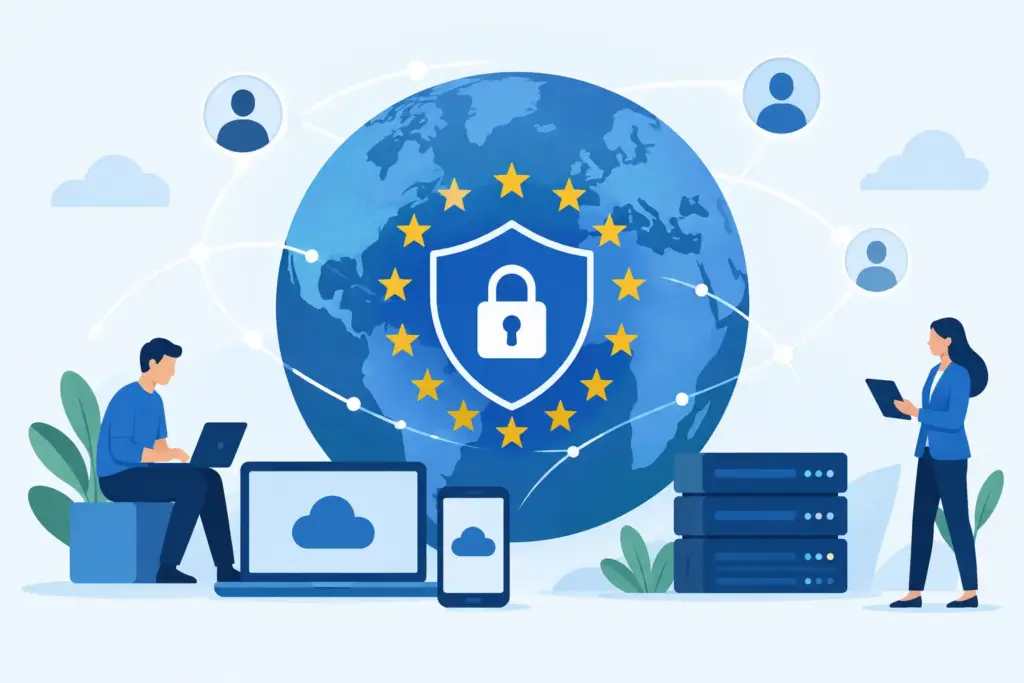
A U.S.-based SaaS company can have no EU office, invoice customers only in dollars, and still face GDPR obligations because users in France, Germany, or Spain can sign up for its platform. The practical question is not simply, “does the GDPR apply globally?” It is whether a company’s specific activities bring its processing of personal data within the Regulation’s territorial scope.
For technology businesses, that assessment often turns on product design, go-to-market decisions, analytics practices, and the way services are delivered across borders. A generic statement that GDPR is “global” is too broad to be useful. The GDPR is an EU law, but it has deliberately wide extraterritorial reach.
Does the GDPR Apply Globally? The Short Answer
No. The GDPR does not automatically govern every organization or every dataset worldwide. It can, however, apply to organizations outside the European Economic Area, or EEA, when they process personal data in connection with defined EU-facing activities.
Article 3 of the GDPR establishes three main routes to applicability. The first is the establishment test. The second is offering goods or services to people in the EEA. The third is monitoring the behavior of people in the EEA. Each route is fact-specific, and each can create significant operational obligations for a company that has never formed an EU subsidiary.
The analysis focuses on the processing activity, not on where the company is incorporated, where its servers sit, or the nationality of the individual. A California AI company processing a German user’s account and prompt-history data may be in scope. A company based in Paris processing data only in the context of an entirely U.S. operation may need a more nuanced analysis for that activity.
The Three GDPR Territorial-Scope Tests
1. Processing connected to an EU establishment
The GDPR applies when personal data is processed in the context of the activities of an establishment in the EEA, regardless of whether the actual processing occurs in the EU. An establishment is not limited to a registered company or headquarters. A stable and effective arrangement, such as a local sales office, branch, or other sustained operational presence, may be enough.
For a cloud provider or enterprise software vendor, the connection matters. If an EU sales team drives customer acquisition while a U.S. engineering team operates the underlying service, the U.S. processing may still occur in the context of the EU establishment’s activities. Corporate structure alone does not resolve the question.
2. Offering goods or services to people in the EEA
A non-EU organization may be subject to the GDPR where it offers goods or services to individuals in the EEA, whether paid or free. The relevant issue is not whether a person can technically access a public website from Europe. A globally accessible website is not, by itself, sufficient.
Regulators and courts look for indicators that a business is intentionally targeting people in the EEA. These can include localized pages or advertising, EU-language marketing beyond what is customary for the business, prices in euros, EU-specific product terms, country selection for EU markets, or active efforts to acquire customers in the region.
A U.S. fintech that markets to French residents, supports European payment flows, and displays euro pricing has a materially stronger EU nexus than a developer-tool company whose English-language site happens to receive occasional traffic from Europe. The distinction can be subtle, which is why product, marketing, legal, and commercial teams should assess planned market expansion before launch.
3. Monitoring the behavior of people in the EEA
The GDPR may also apply when a non-EU organization monitors the behavior of individuals in the EEA, provided that behavior takes place within the EEA. Monitoring commonly includes tracking individuals across websites or applications, behavioral advertising, profiling for decision-making, location-based analysis, and certain forms of online identifier collection.
This is particularly relevant to adtech, mobile applications, analytics-heavy SaaS products, IoT platforms, and AI systems. Persistent identifiers, device fingerprints, telemetry, cookie-based analytics, and inferred user attributes can all be personal data when they relate to an identifiable or identifiable-in-context person.
Not every security log or aggregate usage metric amounts to behavioral monitoring. The risk increases where the data is used to predict preferences, segment users, personalize content, assess risk, or influence decisions. Technical teams should document what data is collected, how long identifiers persist, whether profiles are created, and which teams or vendors can use the resulting information.
What GDPR Scope Means for a Non-EU Company
Once it is determined that the GDPR applies, the requirements are not limited to displaying a privacy notice. The organization must be able to demonstrate a lawful basis for processing, provide transparent information, honor applicable data-subject rights, use appropriate processor terms, and implement security measures proportionate to risk.
For a technology company, this commonly translates into an operating model that covers data inventories, records of processing activities, retention controls, access governance, incident response, vendor due diligence, and privacy review within the product-development lifecycle. If processing is likely to create high risk to individuals, a Data Protection Impact Assessment may be required before deployment.
The GDPR’s accountability principle is central. A business should not rely on an informal view that it is “probably compliant.” It should be able to show why it processes data, which systems and vendors are involved, where data travels, how decisions were approved, and how controls are tested over time.
This is especially consequential for AI, health-tech, and financial-services use cases. Sensitive data, automated decisions, large-scale profiling, and data used to train or evaluate models can raise the compliance threshold quickly. Anonymization claims also need technical scrutiny. Data that is merely pseudonymized, tokenized, or difficult to access may still be personal data under GDPR.
An EU Representative Is Often Required
A controller or processor without an EEA establishment that falls within Article 3(2) will generally need to appoint an EU representative under Article 27. The representative acts as a contact point for supervisory authorities and data subjects on GDPR-related matters.
There are narrow exceptions, including where processing is occasional, low risk, and does not involve large-scale processing of special-category data or criminal-offense data. Those conditions are stricter than many companies expect. A recurring SaaS service that collects account, usage, and support data from EU users may not fit comfortably within the exception.
An EU representative is not a substitute for internal ownership. The company still needs accountable decision-makers, documented processing practices, and a process for responding to regulators and individual requests. Where the scale, nature, or purposes of processing require it, a Data Protection Officer may also be necessary.
GDPR Scope Is Different From Data-Transfer Compliance
A frequent mistake is treating GDPR territorial scope and international data transfers as the same question. They are related but distinct.
A U.S. company may be subject to the GDPR because it targets individuals in the EEA. Separately, it must assess the legal mechanism for transferring personal data from the EEA to the United States or another third country. Depending on the circumstances, that can involve an adequacy decision, participation in an applicable framework, Standard Contractual Clauses, and transfer-risk assessments with supplementary technical or organizational measures.
Cloud architecture matters here. Teams should understand not only the primary hosting region but also support access, backup replication, observability tooling, identity services, subprocessors, and remote administrative access. A claim that data is “stored in Europe” may be incomplete if engineers or vendors outside the EEA can routinely access it.
A Practical Assessment for Product and Compliance Teams
Before entering or expanding in European markets, organizations should perform a targeted territorial-scope assessment. It should examine the legal entity structure, target markets, customer-contracting model, product interfaces, marketing activity, data flows, tracking technologies, and vendor ecosystem.
Four questions usually expose the key issues:
- Do we have a stable operational presence in the EEA, and is the processing connected to its activities?
- Are we intentionally offering a product or service to people located in the EEA?
- Do our analytics, advertising, anti-fraud, personalization, or AI features monitor behavior in the EEA?
- If the GDPR applies, can we evidence compliance across the full lifecycle of the data?
The final question is where many fast-growing businesses encounter friction. A privacy notice drafted for a launch is not enough when enterprise customers ask for data-processing documentation, security evidence, subprocessors, international transfer details, and a clear allocation of controller and processor responsibilities.
The most effective approach is to integrate privacy requirements into commercial and technical decisions early. Map data before selecting vendors. Review tracking before growth campaigns go live. Build rights-request workflows before a large customer demands them. For complex technology environments, practical GDPR readiness is a governance discipline, not a last-minute legal exercise.
For organizations with EU-facing ambitions, a defensible assessment now can preserve product velocity later. It gives teams confidence to build, sell, and operate in the European market with a clearer view of the regulatory risk they are accepting and the controls needed to manage it.